


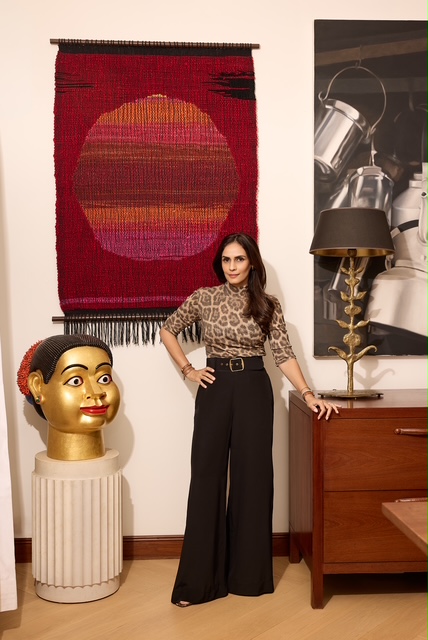
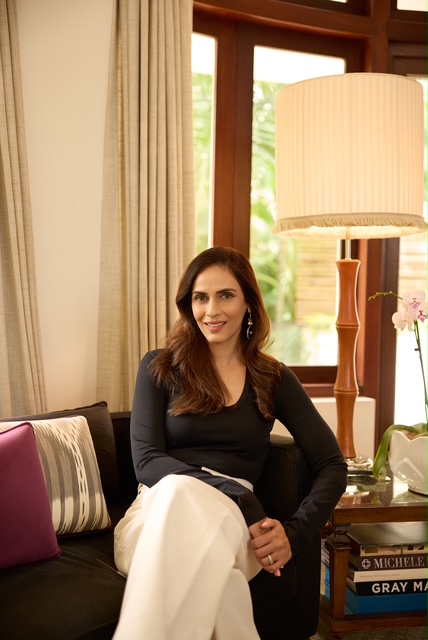
For Krupa Amin, collecting art began with personal encounters. Growing up, she watched her mother and later her mother-in-law form friendships with artists such as Bhupen Khakhar, Jeram Patel and Nasreen Mohamedi. Visits to artists’ studios in Baroda, Gujarat shaped her understanding of art from an early age, while her studies at Sotheby’s Institute of Art in London later opened her eyes to the international art world.
Today, Krupa and her husband Shaunak collect emerging and established Indian artists whose work engages with politics, climate change, identity, spirituality and India’s rich material traditions. Their collection has evolved alongside their friendships with artists and the different stages of their own lives. This commitment extends beyond collecting. Through Space Studio in Baroda, Krupa has provided a platform to more than 350 young Indian artists with the time, space and freedom to experiment, take risks and develop their practices.
LARRY’S LIST spoke with her about the artwork she fell in love with, the kind of artwork that would make her write a cheque without any consideration, the challenges of running Space Studio and her vision for it, as well as her insights on the Indian art scene.
Collecting
What made you want to start collecting art? What is the main motivation behind?
It began with my mother and later, my mother-in-law. They used to meet artists in our hometown, Baroda, a city in the state of Gujarat — Bhupen Khakhar, Jeram Patel, Nasreen Mohamedi — and collect their work as friends. As a teenager, I remember visiting Jeram Patel and K.G. Subramanyan’s studio with my mother; just listening to them talk changed how I understood what an artist even was. That stayed with me.
Studying Art History at Sotheby’s Institute in London in 2003 opened me up to museums and galleries internationally. When I came back to India in 2006, I gravitated toward the young artists working in Baroda, and that grew, over time, into an interest in artists across the country. My collecting has always come from curiosity; I want to live with work that keeps making me think.
When did you fall in love with a piece of art? What was it?
I joined Bodhi Art in 2006, and that is where I first became fascinated by Shilpa Gupta’s work. In 2008, I bought “1000 Queues”, which is a series of photographs of queues, formed for all kinds of different reasons across India, brought together into one piece. What I loved was that the idea was so simple, but it grows the more you look at it; it includes ideas about society, politics, identity and the way people live together.
What is your focus regarding the artists in your collection? Are you more interested in emerging or renowned artists?
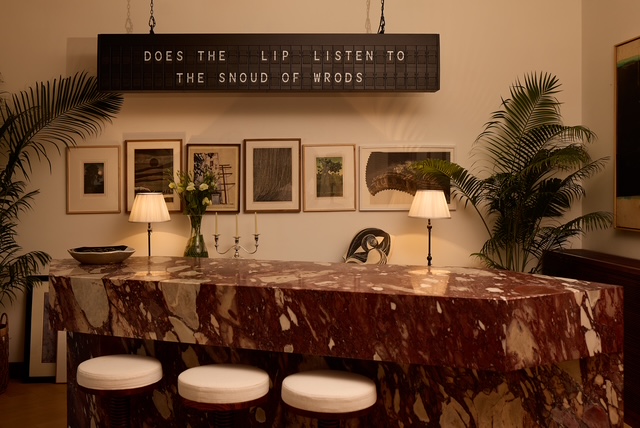
My husband Shaunak and I collect a mix of emerging and established Indian artists. Reputation and market value aren’t really the filter; instead, we go after ideas that move us or make us see the world a little differently. Looking at the collection as a whole, certain themes keep resurfacing: politics, climate change, the cosmos, questions of identity and self, and the long history of textiles and materials in India. I suppose those are the things I find myself thinking about anyway, so it makes sense they have found their way in.
Is there any particular type of art that has consistently attracted you, or anything that unites all the works you have acquired?
There is no single medium or aesthetic that defines the collection. What connects the works is emotional and political, more than visual. I am drawn to artists who have something to say about the world we live in, whether it is about politics, the environment, spirituality, identity, or material. I also love catching artists early and watching how their practice develops over the years.
What was the first and the latest artwork you purchased? How many artworks do you own?
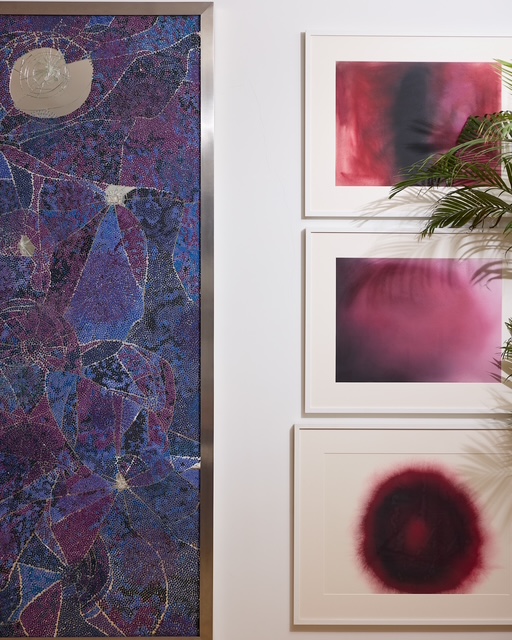
The first was by a young Baroda-based artist, Prajjwal Choudhary — a 6-by-6-foot piece made entirely of small matchboxes, each printed with artist portraits and images of their work. It was visually striking, and my husband and I bought it together in our 20s. It felt new and exciting, and it meant a great deal to us at that stage of our lives. The most recent is a canvas by a dear artist friend, N.S. Harsha. I like that the collection has no real beginning or end, as it has grown alongside our friendships with artists and alongside the different phases of our own lives.
Where do you display your collection? Have you ever presented/ Would you wish to present your art collection publicly?
Our family has had a very long association with Baroda, and our connection with art goes back several generations. In fact, in the 1950s, Sankho Chaudhuri created a mural on one of our factory buildings, which was one of the earliest ways in which the family began engaging with art and artists. Over the years, we have continued that relationship through public art commissions and other projects across the city. The collection is currently split between our homes in Mumbai and Baroda, and it would be wonderful, at some point, to bring it together and display it permanently within the family’s Art District in Baroda—once it feels like it tells a complete story of who we are and what we care about. In that way, the works we have collected over the years could become part of the larger cultural landscape we’ve been building in the city.
Is there any kind of artwork that can make you write a cheque without any consideration?
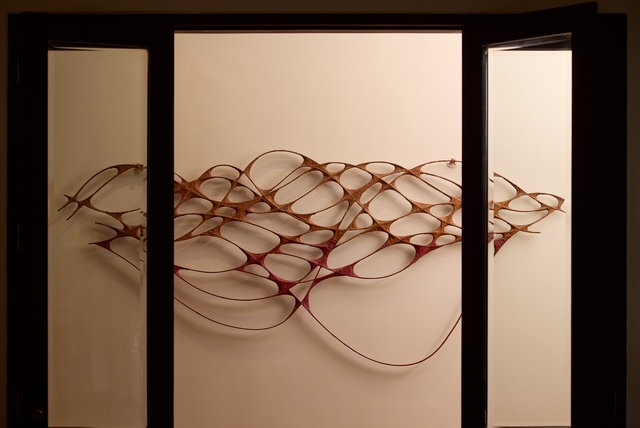
A hemp work by Mrinalini Mukherjee. I have always been drawn to her work. She also studied at the Baroda School and developed a completely distinctive visual language that was ahead, while staying in real dialogue with Indian art of the 1970s.
What I love is the way she took traditional, organic material, like hemp, and transformed it into something sculptural and powerful and almost otherworldly.
How important is it for you to meet the artists who created the artwork?
I believe I have had a conversation with most of the artists in my collection. It is important, but sometimes it may not be possible – what matters is to be knowledgeable about the artist and their ideas. My relationship with artists through Space Studio has made this especially important to me. Through my residency, I meet artists from every part of India, and it’s fascinating to see how such different life experiences shape their practice. An artist from the residency – Gurjeet Singh, from Chandigarh- spent time with us in Baroda and shared stories of his mother at the sewing machine— a childhood memory that later became the foundation of his cloth sculptures. Over the years, I’ve come to know the journeys of over 200 artists through their art. Every three months, our Open Studios opens this world to a local audience, giving them a chance to engage with the artists and their work in the intimacy of a studio setting. A work becomes much more meaningful once you understand something of the person and the ideas behind it.
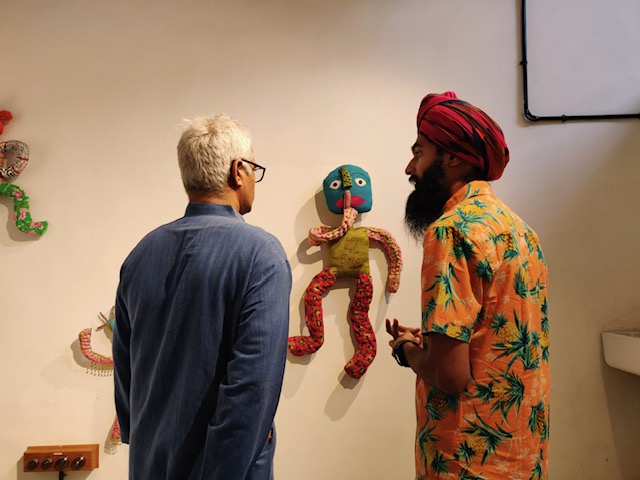
Collective studio – Space Studio
What motivated you to set up the community studio called Space Studio?
It grew organically out of my own journey with artists. Having grown up around artists in Baroda and later working in the art world, I saw firsthand how much young artists need time, space and support to develop a meaningful practice. For many emerging Indian artists, access to a large, independent studio space was—and remains—difficult to find.
I wanted to create a place where artists could step away from the pressures of everyday life, have the freedom to experiment, and, importantly, engage in conversations with other artists and the wider community.
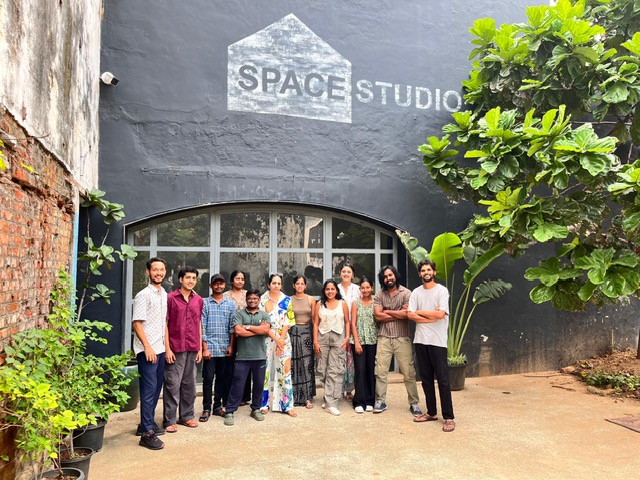
Over the years, Space Studio has grown into something much bigger than a residency. Not only do we provide access to mentorship sessions and physical resources, but we have also connected the Indian artist and the ecosystem in many ways. We have hosted exhibitions by prominent artists including Nasreen Mohamedi and Gulam Mohammed Sheikh, and invited artists such as Sudarshan Shetty, Atul Dodiya and Lubna Chowdhary to engage with the local community. We have supported emerging artists including Ayesha Singh and Akshata Mokashi in presenting their work at art fairs in Mumbai and Delhi, and have collaborated with leading galleries across India to create platforms for young talent. Over the past 20 years, more than 350 artists have benefited from our programmes. At least 150 of these artists have gone on to have significant exhibitions with galleries and curators across India.
Why did you choose the city of Baroda to set up the Studio?
Baroda was the obvious choice. I grew up visiting artists there with my mother and had an early connection to the Baroda School and the Faculty of Fine Arts at MS University.
There has always been a strong culture of dialogue among artists in Baroda. I wanted to add to that by building a space where artists could develop their work away from the commercial pressures of the bigger cities and utilise resources available in Baroda, which has a strong history of an established artist community.
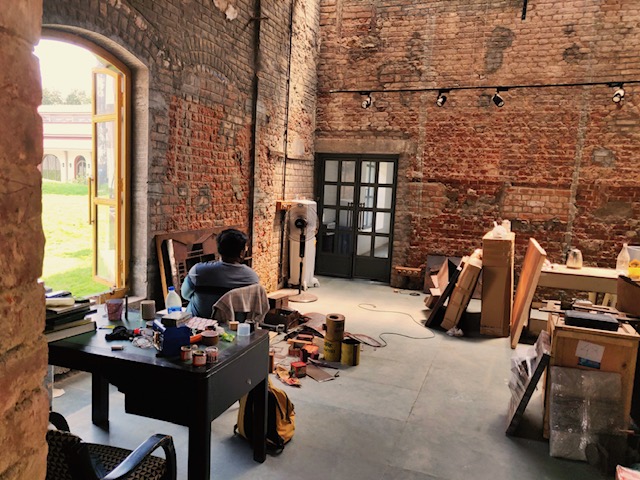
How does it work with the artists? Is it free for them to stay? Do you help to promote their art?
Artists receive accommodation, studio space, meals and, most importantly, time—all completely free of cost. We don’t direct what they make or expect a particular outcome. The whole point is to give artists the freedom to experiment, take risks, and develop their practice on their own terms. The studios are part of a larger 20,000-square-metre our family run art district – the Alembic Art District in the heart of Baroda- so the residency extends well beyond the studio itself. Artists have access to cafés, restaurants, co-working spaces and even a skate park, alongside a busy programme of music and cultural events.
The district is particularly active on weekends, when local communities come in and often wander into the studios to meet the artists and see what they’re working on. I think that interaction is an important part of the experience—it creates a sense of exchange between the artists and the wider community, rather than having them work in isolation.
We have connected them with curators, galleries, collectors and other artists through studio visits, exhibitions, and conversations. We continue to promote their work long after they leave through our annual alumni shows. These have taken place either in Baroda or in collaboration with galleries such as Vadhera in New Delhi, Chemould Colab and Akara Art in Mumbai, as exhibitions showcasing young talent.
What are the challenges in running the Studio? How do you plan to develop it in the upcoming five years?
The biggest challenge is sustaining a non-profit while still giving artists meaningful support and building the right team to hold all of that together.
Over the next five years, I want the program to grow stronger and more holistic, with more international collaborations, more opportunities for curators and researchers to engage with the residency. But above all, I want to protect what makes Space Studio special to me — a place where artists feel free to experiment, connect, and find their own way.
The contemporary art scene in India
You said before that Indian art needs to be showcased and appreciated in its own country. In your view, how can you or other collectors and your country improve on this?
Space Studio Baroda is my own small contribution. Through the residency and our programs, we support young artists and create opportunities for them to exhibit and connect with audiences, sometimes outside the commercial gallery system entirely.
India has an extraordinarily rich art and heritage ecosystem, but there is still a much bigger need for patronage, both from private collectors and from government institutions alike. We need stronger museums, more independent institutions, more fellowships, and more spaces where artists can simply experiment without thinking only about the market. That said, the last decade has brought real momentum: Kiran Nadar Museum of Art in Delhi, the Bhau Daji Lad Museum in Mumbai, the Bihar Museum, and simultaneously, the ecosystem of galleries, collectors and artist-led spaces has genuinely grown.
Where are your favorite places to discover contemporary art in India?
Art fairs in Mumbai and Delhi, and the metro gallery circuit, are still where I discover a lot of contemporary art, but I like going beyond that too. The Kochi-Muziris Biennale, the Serendipity Arts Festival and the Bengal Biennale interest me because they place contemporary art in such different cultural and architectural settings.
I also find real value in visiting artists’ studios and residencies, like Khoj, where the conversations tend to be far more personal than anything you get at a gallery or fair.
A recent visit to Pondicherry added to this. I am particularly fond of ceramics, and it was wonderful to visit the studios of prominent ceramists such as Rakhee Kane and Indrani Singh, as well as the Golden Bridge Pottery studio.
Can you name three emerging Indian artists who should be on our radar?
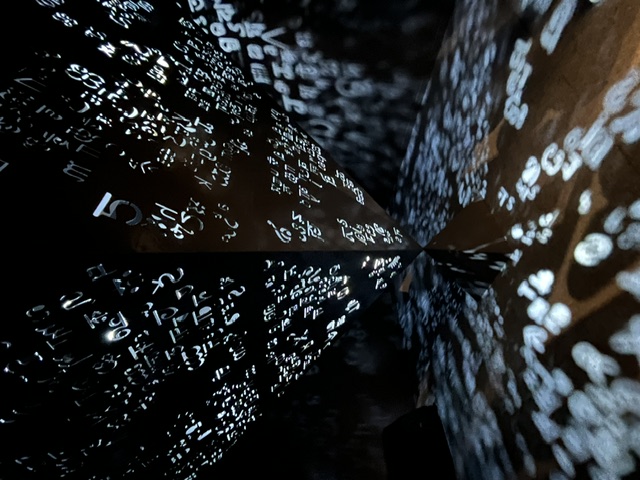
Gurjeet Singh, represented by Chemould CoLab, Neeraj Patel, represented by Nature Morte, and Soghra Khurasani, represented by TARQ, are all alumni Space Studio artists who have come a long way since their residencies and established solid, distinctive practices. Gurjeet works across textiles, sculpture, painting and performance, using colourful soft sculptures and found materials to explore identity, memory, love and loss.
Neeraj’s paintings and paper works sit between abstraction, technology and industrial landscapes, often using codes, fragmentation and layering to reflect on systems, industrialisation and ideas of progress. Soghra is a printmaker whose woodcuts and etchings draw from nature, soil and vegetation, transforming landscapes into meditations on growth, decay, resilience and our relationship with the earth. I’ve followed all three since their time at Space Studio, and it’s been really rewarding to see how each of them has developed such a strong and individual voice.
Website: www.spacestudiobaroda.org
Instagram: @kroopa81
