


An advisor who grew up on weekend gallery visits with her father, and a former Red Cross delegate who now runs a queer art gallery in a Chinatown shophouse in Bangkok. During the opening week of the Bangkok Art Biennale, LARRY’S LIST sat down with Ning Chong and Olivier Chow at Soho House Bangkok to talk about the many hats a collector wears today. Some conversations need the right room.
On the evening of 30 October 2026, the amazing Soho House Bangkok opened its doors to members and guests for “The Many Roles of a Collector in Today’s Art World”, moderated by LARRY’S LIST co-founder Christoph Noe. The evening continued a conversation that began earlier this year in Ibiza. In June, LARRY’S LIST hosted a talk at Soho Farmhouse Ibiza, in parallel and in collaboration with CAN Art Ibiza, the island’s contemporary art fair, now in its fifth edition. The timing in Bangkok could hardly have been better. With the Biennale spread across BACC, the National Museum and other sites in the city, and galleries and new private spaces opening, Bangkok is a city that the art world increasingly talks about.
Ning Chong arrived from Singapore. She began her career at Singapore’s National Arts Council, ran the Singapore Art Week campaign and worked on two editions of the Singapore Pavilion in Venice. Then her father, a collector since the 1980s, “hoodwinked” her into cataloguing his collection of more than 400 works. That sabbatical turned into a private salon-gallery that she ran for nine years, and later into an advisory that helps families and corporations look after what she calls the second half of a collector’s life cycle: cataloguing, valuation, insurance and, ultimately, legacy. Last year she produced Artist’s Proof: Singapore at 60, a privately funded exhibition of more than 90 works by 54 artists, built around a historic bronze bust of Lee Kuan Yew and seen by some 7,000 visitors.
Olivier Chow‘s road was even less direct. Raised in a collector family but determined to find his own way, he spent years with the ICRC before studying African art and opening his first gallery in Lausanne, very much inspired by the time he had spent visiting galleries in Cape Town and Johannesburg. A year ago he came to Bangkok, fell for Chinatown, and moved into a shophouse with the gallery downstairs and his home upstairs. His programme focuses on queer artists, offering a safe space at a time when queer expression is under pressure in many places.
What connects them is a belief that collecting is personal. Olivier still remembers the first work that really spoke to him, a piece by Aboudia about the war in Ivory Coast. Ning collects Asian women artists, because themes of motherhood, identity and labour started to resonate once she had children. Both warned against simply following trends. And both see Bangkok’s moment as real, driven by energy on the ground, new spaces in Chinatown and international galleries slowly arriving.
Below are edited highlights from the conversation.
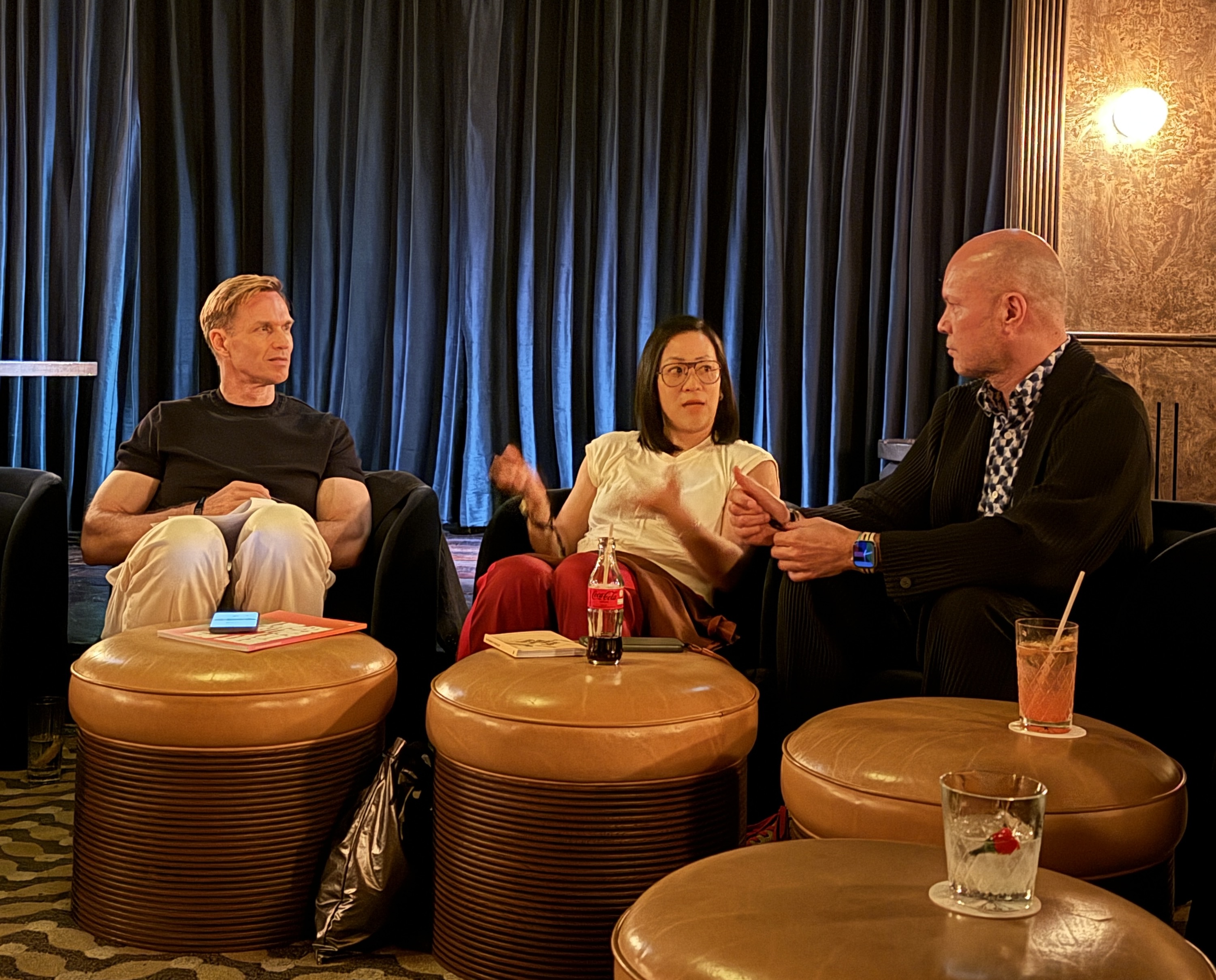
Ning, you came for the Biennale opening. What stayed with you?
Ning Chong: The National Museum. The Biennale was given the royal throne room, which has never been used as a venue before. You walk through huge double-height wooden doors into a gilded hall with the throne at the back, and the works inside hold their own. It is majestic. I was also pleased to discover artists I would never have met at a fair or in a gallery.
Olivier, why Bangkok, and why Chinatown?
Olivier Chow: It wasn’t obvious at first, but the more time I spent here, the clearer it became. I fell in love with Chinatown, and a friend had a beautiful shophouse where I could finally picture the project. Bangkok is a queer city. While many places are cracking down on queer expression, I wanted a safe space for queer art.
Bangkok is on every collector’s radar. Hype or the real thing?
Olivier Chow: In the year I’ve been here I’ve watched it progress. International galleries are slowly coming in, and many collectors have secondary homes here, from Hong Kong, Singapore and Manila. The more people talk about it, the more people want to be here.
Ning Chong: You hear everywhere that Bangkok is flourishing: private capital, infrastructure, brands arriving. So this is a learning trip for me. Where is the action on the ground? I’m still an observer, but I’m all for building bridges.
Ning, what did your father’s collection teach you?
Ning Chong: It had never been catalogued, and we had to decide whether to put it all into storage or do something with it. So I stumbled into creating a private gallery, with no playbook. Handling an eclectic collection of more than 400 works taught me that if you ever want to do a show, you need coherence.
Why focus on what happens after the buying?
Ning Chong: People buy, buy, buy, and then what? Your family office, bankers and lawyers look after your traditional assets, but what about your passion assets? Whether you sell, keep or donate, it all starts with knowing what you have. Cataloguing is the bedrock. Legacy is the apex.
What was the first work you really fell for?
Olivier Chow: A work by Aboudia that I saw in the Pangaea exhibition at the Saatchi Gallery. His work on the war in Ivory Coast spoke to me immediately. Later I sold it to give my first gallery a charismatic piece. Maybe one day it finds its way back.
Ning Chong: For the longest time I didn’t buy, because my dad was the buyer and I did the paperwork. I only started three or four years ago with my husband, once I had my own point of view. I focus on Asian women artists to keep it coherent.
Olivier, does the gallerist in you look at art differently from the collector?
Olivier Chow: I only want to show work I would have in my own home. I know some pieces will be a hard sell, and I still show them because they make sense in the curation.
Ning, which hat do you enjoy wearing most?
Ning Chong: I code-switch all day. For my dad I’m the sounding board, the last door before a bigger purchase, and I ask how a work fits the collection, because I know it is going to follow me. For new clients I explain how the market works. But what I enjoy most is producing projects like Artist’s Proof. Seeing visitors come back in the last days with their kids or their parents was heartwarming.
Why is succession such a difficult topic in Asia?
Ning Chong: It’s still very new here. Without the inheritance taxes of Europe or North America, heirs have little incentive to do anything; if they can afford it, they just keep it. Or they don’t know what they have and get taken advantage of. It’s a shame, because heritage that would benefit institutions gets lost.
What would you tell someone who wants to start collecting tonight?
Olivier Chow: Be passionate about the piece. Don’t follow trends or what people tell you. Learn about it, and keep it authentic.
Ning Chong: Buy what you love, but set a budget, with something extra for framing, installation and conservation. If you gravitate to certain galleries, follow them and build the relationship. And do studio visits.
Further reading
Soho House Bangkok
Adult Material Gallery
FOFA
