


On the occasion of Révélations China 2026, Durjoy Bangladesh Foundation and Zannat Jui Architects brought together an architect, a textile artist, a patron and a museum director in Shanghai to talk about a house wrapped in Jamdani – and about what it means to build a home when the ground beneath it cannot stay.
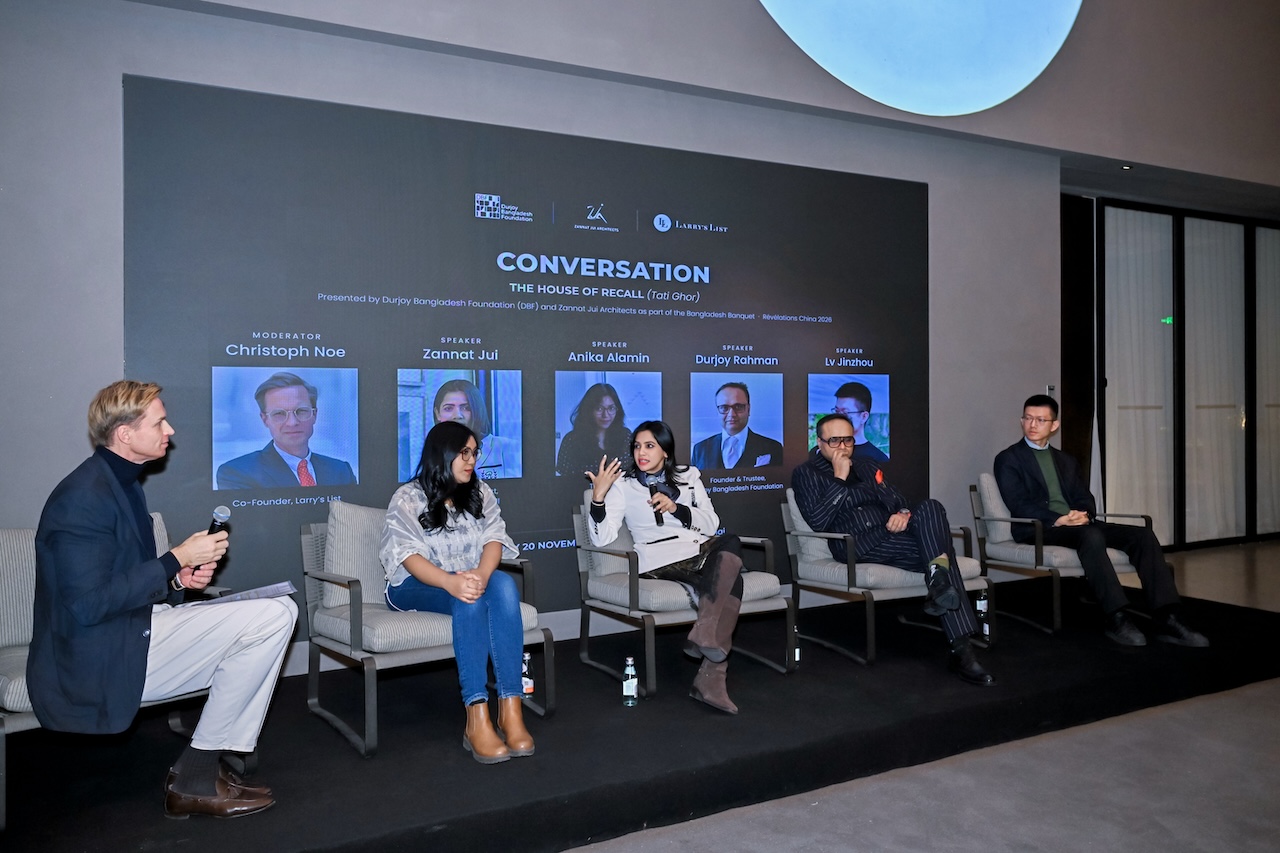
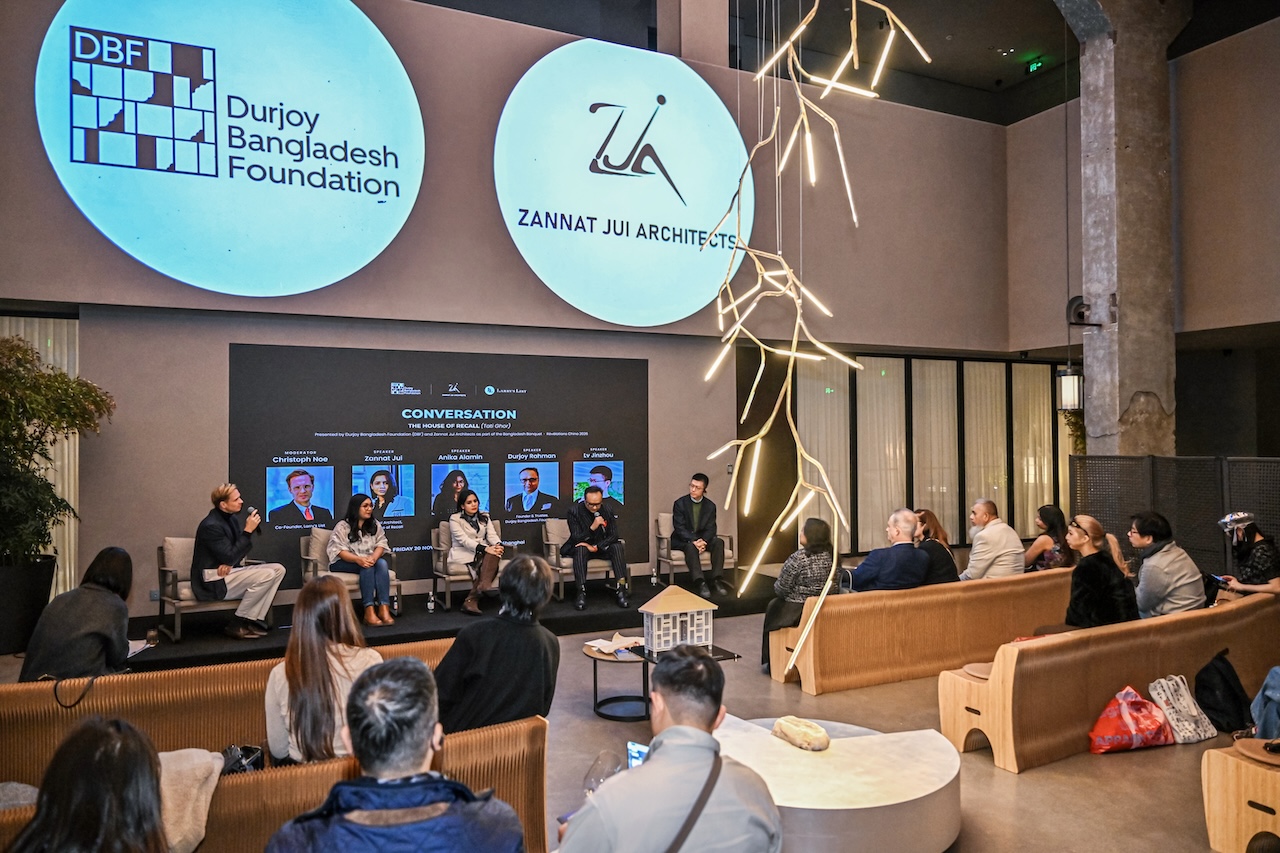
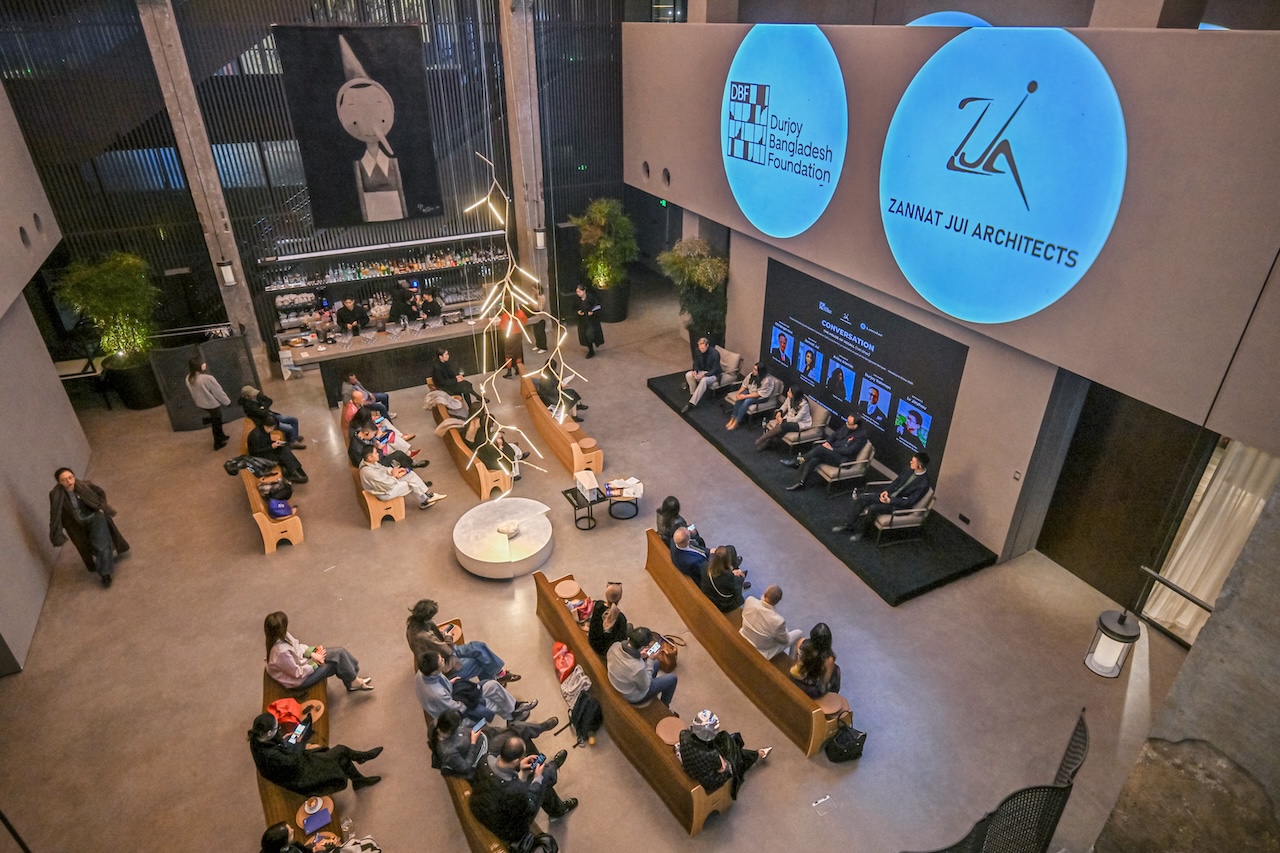
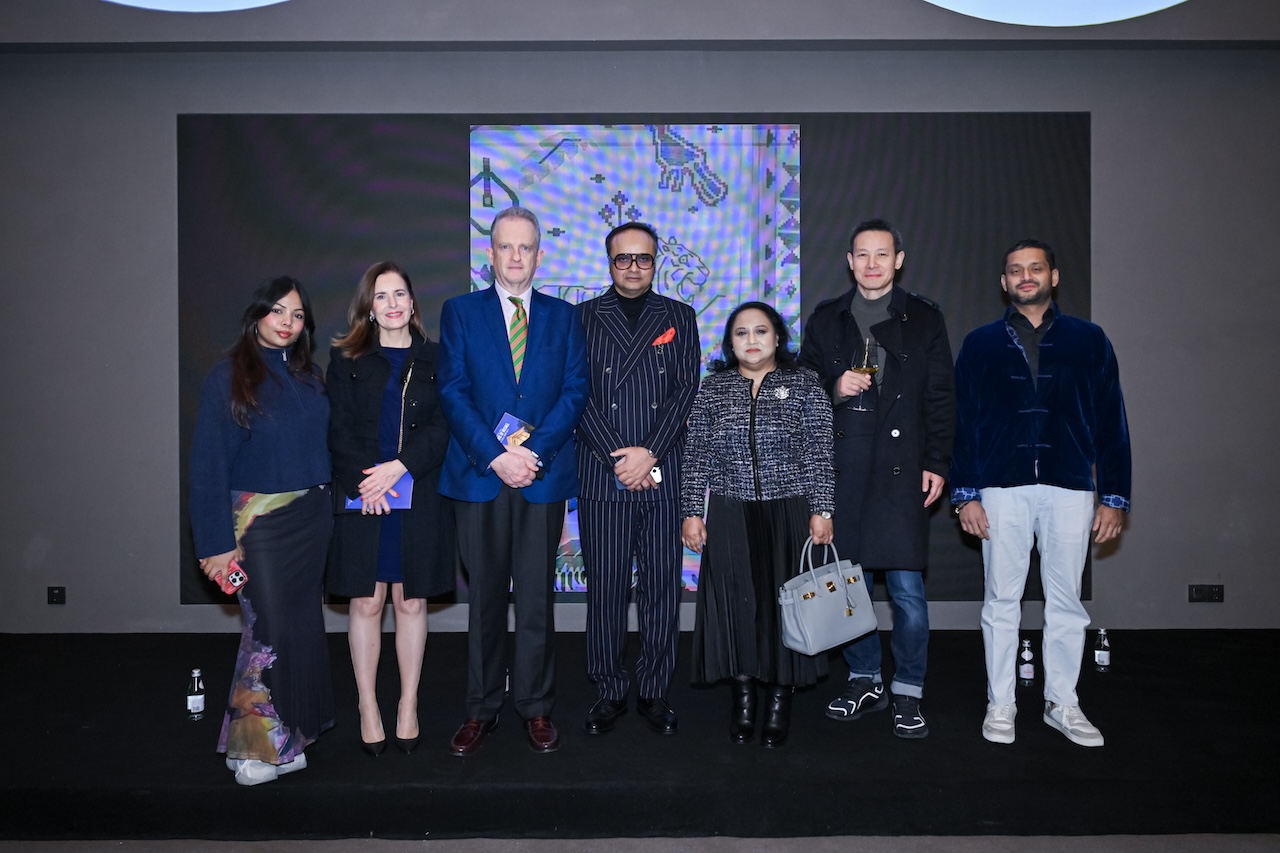
On the evening of Friday, 20 November, guests gathered at CHARCOAL Shanghai in Huangpu District for a conversation celebrating The House of Recall (Tati Ghor).
The installation was presented by Durjoy Bangladesh Foundation (DBF) as part of the Bangladesh Banquet at Révélations China, the International Fine Craft & Creation Biennial, which ran from 19 to 23 November at the Shanghai Exhibition Center. The house stands more than four and a half metres tall and is wrapped in handwoven Jamdani. Its form is modelled on the “readymade” houses of Munshiganj in Bangladesh, which local communities developed in response to repeated river erosion. These houses can be taken apart, moved and rebuilt when the river claims the land. Inside, a Shital Pati mat by master craftsperson Gitesh Chandra Das covers the floor, and a 16-shaft loom threaded with indigo-dyed yarn brings the act of weaving into the space.
On stage were the house’s principal architect Zannat Jui, textile artist Anika Alamin, DBF founder and trustee Durjoy Rahman, and Lv Jinzhou, Executive Director of the H+ Art Museum in Suzhou, which opened in January 2026 in a building by Tadao Ando. The conversation was moderated by Christoph Noe of LARRY’S LIST. The evening also marked a long-standing partnership: LARRY’S LIST has worked with DBF since the foundation’s early days after it was established in 2018. The Shanghai conversation is the latest chapter in that relationship, not the beginning of a new one.
A Collaboration From the Start
A theme ran through the whole evening: no one on stage claimed the house as theirs alone. Zannat Jui described it as a truly collaborative project, built on Durjoy Rahman’s vision. The first idea came from Rahman. Jui joined as architect, and Anika Alamin then brought in the textile and weaving work. Master weaver Md Rajon Mia, Shital Pati master Gitesh Chandra Das, and a team of engineers, curators and researchers completed the circle. Rahman took this further. He stressed that the project depended just as much on the people whose names rarely appear on a wall label: the workers who built the structure, the steel makers who produced the frame, and the craftspeople who wove and finished every surface. It is a point he has made before. Ahead of the fair, he said that “visibility alone is not enough,” and that DBF also wants greater recognition for the artisans themselves and the knowledge passed down through generations.
Rahman also tied the Shanghai presentation to a much older history. Sonargaon, regarded as the birthplace of Jamdani, was documented in the fifteenth century by Ma Huan, the translator on Admiral Zheng He’s Ming dynasty voyages, as a thriving centre of textile trade. Fine muslins from the region reached the Ming imperial court. For DBF, bringing Jamdani to China revisits that relationship in a new context. It also continues a path that began with the foundation’s participation at Révélations Paris in 2025.
The whole team shared their delight that the house had been given such a prominent position inside Révélations. For a project about people who are so often overlooked, that visibility mattered.
Building for the Exhibition Hall
For Zannat Jui, the project meant a change of perspective. An architect, she noted, usually builds for the outside world: for people who will live, work and shelter in a building. Designing a house for an exhibition hall is a different exercise. The structure no longer has to keep out the monsoon; instead it has to carry a story and make visitors feel something.
The question behind the project is a simple one. In the press materials Jui put it this way: “what makes a home when the ground beneath it cannot remain permanent?” Her hope is that visitors leave with a moment of empathy for people who must rebuild their lives each time the river takes their land – and with a sense that everyone deserves a safe place to live with dignity.
New Motifs, Old Knowledge
Anika Alamin spoke about the courage it took to try something different. Traditional Jamdani draws on delicate geometric versions of flowers, leaves and creepers, and avoids human and animal figures. For The House of Recall, she set out to tell the story of Bengal through its flora and fauna. Her starting point was “Bagher para”, or “tiger’s claw” – a traditional floral pattern named after a tiger – together with research into the collections of the Victoria and Albert Museum. From there she developed designs that move from the geometric towards the illustrative. Translating those drawings into cloth was only possible with the master weavers of Sonargaon, and Alamin said how much she had learned from them. The learning ran both ways. Md Rajon Mia, who has worked with Jamdani for 28 years, called the project a completely new learning experience. Weaving new motifs at such a large scale, while keeping precise measurements by hand, had been particularly challenging for him.
Craft in the Age of AI
Lv Jinzhou brought a view from outside the project and from a city with its own deep textile heritage. Suzhou is known for its silk and Su embroidery. His museum, H+ Art Museum, sits on the Shangtang River in the city’s historic Gusu District and runs its own embroidery art project alongside its exhibition programme.
Asked why handcraft is enjoying such strong interest today, Lv offered a clear answer. In his view, the popularity of craft is a counter-movement to AI and technology. The more of daily life is shaped by screens and machines, the more people value objects made slowly, by hand, by someone they can name. A Jamdani panel that can take from a week to several months to weave is the opposite of instant. Lv also spoke about how a museum listens to its public. He said he is keen to hear audience feedback across many channels, including social media. For a museum that opened only this year, that dialogue is part of finding its place in the city – and it fits his wider aim of making a museum feel approachable rather than intimidating.
A Dinner With Old and New Friends
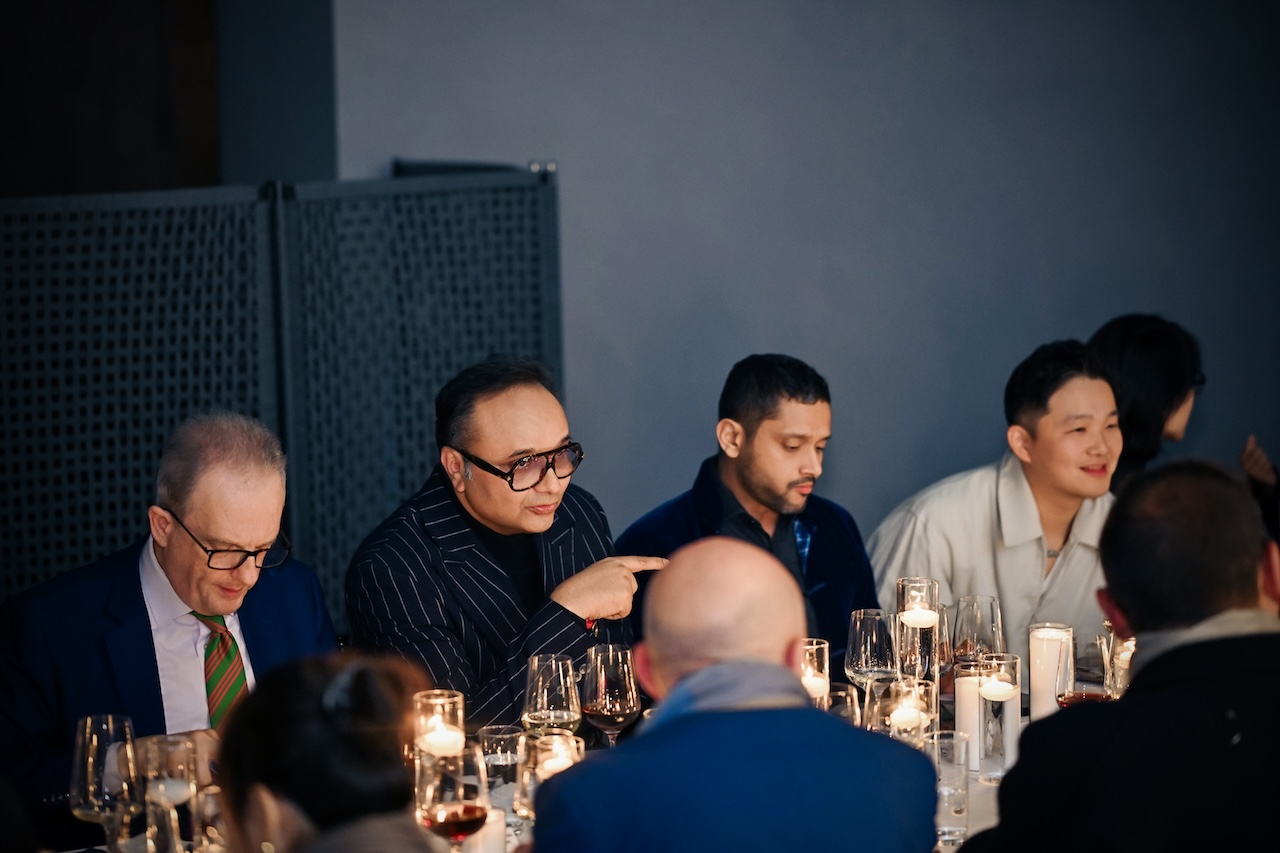
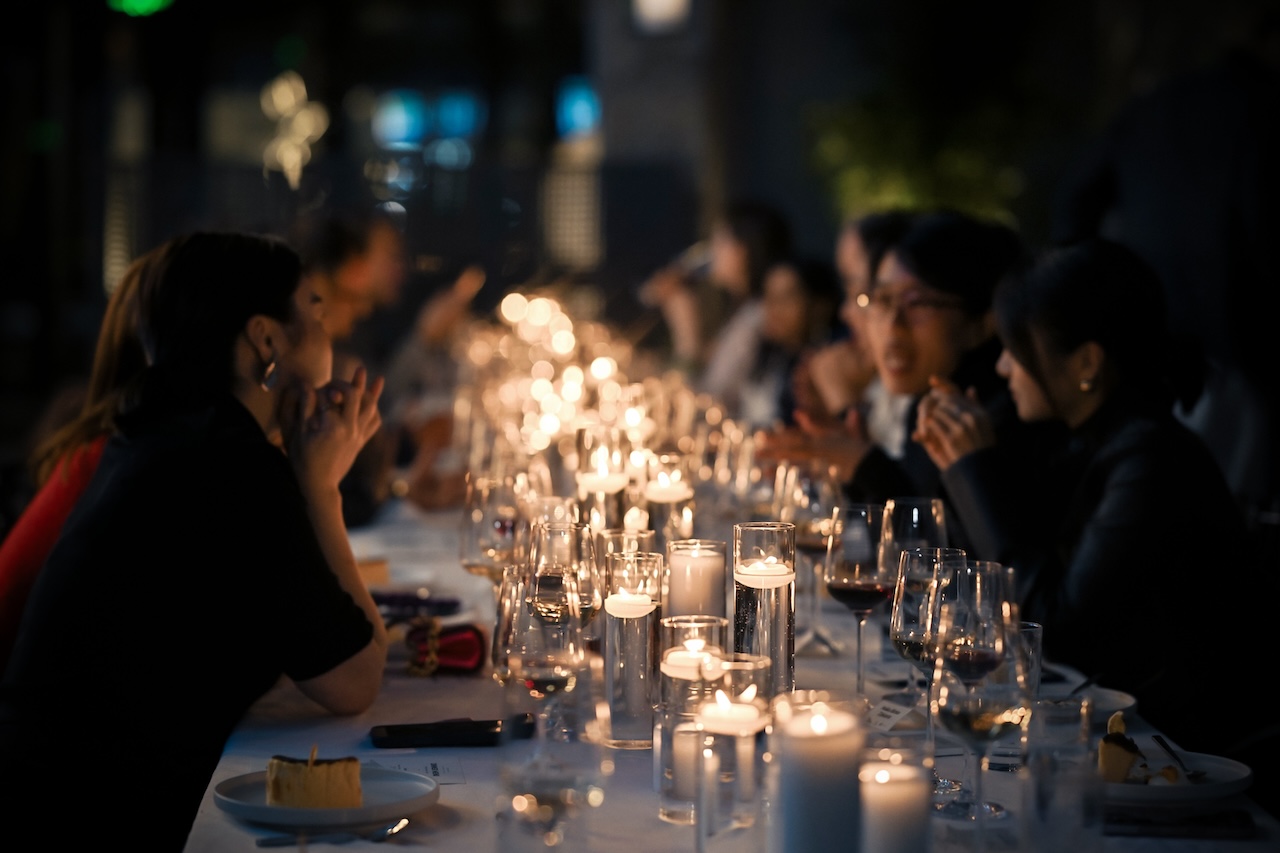
After the conversation, guests stayed on for a sophisticated and exquisite candlelit dinner. Around the table, the evening’s themes carried on in smaller groups: the place of craft in contemporary art, and the long history linking Bengal and China. Guests from media, architecture, embassies and the wider art world made new connections and new friends.
The evening reflected what “The House of Recall” sets out to do. It is a house built to move, wrapped in a craft that has survived colonial disruption and continues in the villages around Dhaka. In Shanghai, it brought together makers, patrons, institutions and audiences who might otherwise never have met – and gave the artisans behind it the recognition they deserve.
Révélations China 2026
“The House of Recall (Tati Ghor)” is part of Révélations China – International Fine Craft & Creation Biennial (Second Edition), presented within the Bangladesh Banquet.
Dates: 19–23 November 2026
Venue: Shanghai Exhibition Center, 1000 Yan’an Middle Road, Jing’an District, Shanghai 200040, China
Website: revelations-china.com
