


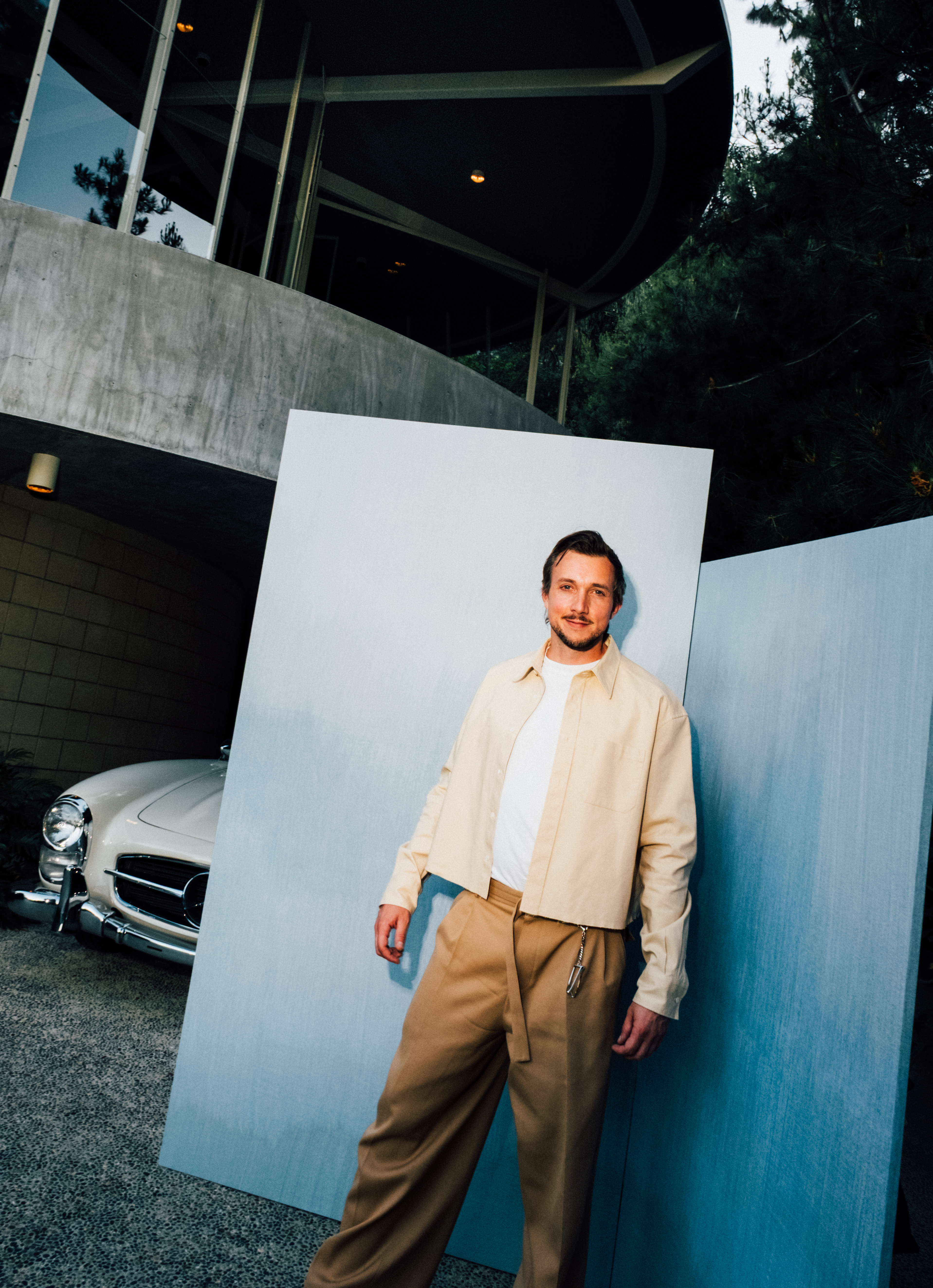
When Oskar Bocquillon describes himself as a “spatial storyteller,” the title fits better than those on most business cards. French-Australian by birth, Paris-forged by career, and now Los Angeles-based, Bocquillon is Head of Creative Spatial Experiences at WHY Architecture — the multidisciplinary practice founded by Thai architect Kulapat Yantrasast that has quietly become one of the most consequential names in cultural design. WHY’s portfolio reads like a roll call of the world’s most ambitious cultural institutions: the Michael C. Rockefeller Wing at The Metropolitan Museum of Art, the Dib Contemporary Art Center in Bangkok, the Academy Museum of Motion Picture Arts & Sciences in Los Angeles, and most recently new departments of Byzantine and Eastern Christian Art at the Louvre Museum alongside the refurbishment of the Roman antiquities trail.
Bocquillon arrived at WHY with a decade of luxury brand experience behind him — eight years designing the physical image and special projects of Christian Louboutin, seasons with Louis Vuitton, 300-plus events at Paris agency Auditoire — and brought with him an obsession not with how spaces look, but with how they feel. This year, he designed LOWKEY, a private club in the heart of Paris. And at Salone del Mobile, he delivered his most personal project yet: “When Apricots Blossom,” a full palazzo takeover for Uzbekistan at Palazzo Citterio curated by Yantrasast.
LARRY’S LIST sat down with Oskar Bocquillon during a heady week in Milan to speak about his transition from the world of high luxury to the center of global cultural design.
Your trajectory spans luxury brand experience — Christian Louboutin, Louis Vuitton — through to cultural and civic architecture. How has that path shaped what you now mean by ‘spatial experience’?
I describe myself as a spatial storyteller. I studied architecture at Sydney Uni and then at UC Berkeley, and at the end of my Masters, I was designing a lot of furniture and objects. That brought me to the design fair in Milan, and at Salone in 2012, I had a revelation. I discovered these incredible brands creating immersive experiences and realised that the architecture practices I was working in weren’t reflecting my passion for design and creating. I went looking for a job in scenography and spatial design, found one in Paris, and never got on the flight back to Australia.
From there, I worked with the Architecture Association of London on a summer school around ‘Designing Desire’ with Louis Vuitton — my first step into luxury. Then I joined Auditoire, a global events agency in Paris, and designed over 300 events for them and others. It was almost like a second schooling. Christian Louboutin then called and asked to bring that expertise in-house. Over the course of eight years, I had the privilege to work very closely with Christian on all kinds of creative projects for both the brand and the man. I led global creative for fashion week presentations, image pop-ups, 360 activations, exhibitions, hotels, bars, galas, artist collaborations, campaigns, window displays… it was a very exciting time of testing, collaborating and creating, always with a touch of humour and a deep appreciation for craftsmanship and (pop) culture.
My journey — from luxury fashion to cultural architecture — gave me a heightened sensitivity of execution and a project-adapted freedom to design. Each project is different. I approach with the same curiosity to dive deep into the idea and intuitively execute it through spatial experience. The same codes apply whether I’m doing a nightclub or a pavilion for a government.
Why describes itself as creating lasting connections between people, culture, and place. How does that ethos translate concretely when you’re designing an immersive environment — whether a nightclub or a cultural pavilion?
When I joined WHY Architecture and started collaborating with Kulapat, we were both very much aligned on this: How can we propose a new approach to design that comes from spatial storytelling, from the experience of the body through space?
You can have the most beautiful building, but if it doesn’t promote connection or emotion beyond something beautiful, it is missing something. Everything I do is created with empathy, seamlessly integrating the human experience into every aspect — moments that will be remembered, the human connection and the consciousness of being present in the now.
Do you conceive of an immersive space as telling a story? If so, what are your tools — sequence, material, light etc. — for choreographing that narrative journey through a space? Any preferred elements? Some hacks you can share that always work?
It starts with a strong concept, the storytelling, followed by its execution in space. Give the concept clarity, and space becomes the medium through which it is made tangible.
Space, for me, is just another medium for telling stories — like film, literature, music or theatre. What differs is that we build worlds experienced by the body before the mind.
Sometimes space is the focus, sometimes it becomes the environment in which other mediums can exist. That intersection is where something exciting happens.
Scale and playful design details add depth and meaning to the narrative. That’s what differs about my approach from a more traditional architectural response that might begin and end with form.
Perspective is crucial — how the body moves through a sequence, how things are revealed or withheld. I’m interested in intrigue, in the suggestion that another world may exist just beyond what you can see; It doesn’t have to be loud, obvious, but when you feel something, it stays with you. My instruments are physical and ethereal: light, sound, technology, texture and materials, smell, scale, even temperature. Light is the big one — you can cheat anything with lighting. I put enormous importance on it, and that comes directly from my years in luxury fashion. There is an element of spectacle in what I do, but it’s spectacle designed so that you yourself become part of it, the atmosphere, the goosebumps — that’s the measure of success.
The other key ingredient is tempo — just like music, my designs go faster and slower, intensity builds and releases.
Crossing from the street into a club, or from a public square into a pavilion, is a charged moment. How deliberately do you design the threshold — that first instant of entry — and what should it do to a visitor emotionally?
Starting with the threshold is absolutely deliberate. The portal is what takes you away and transitions you into space.
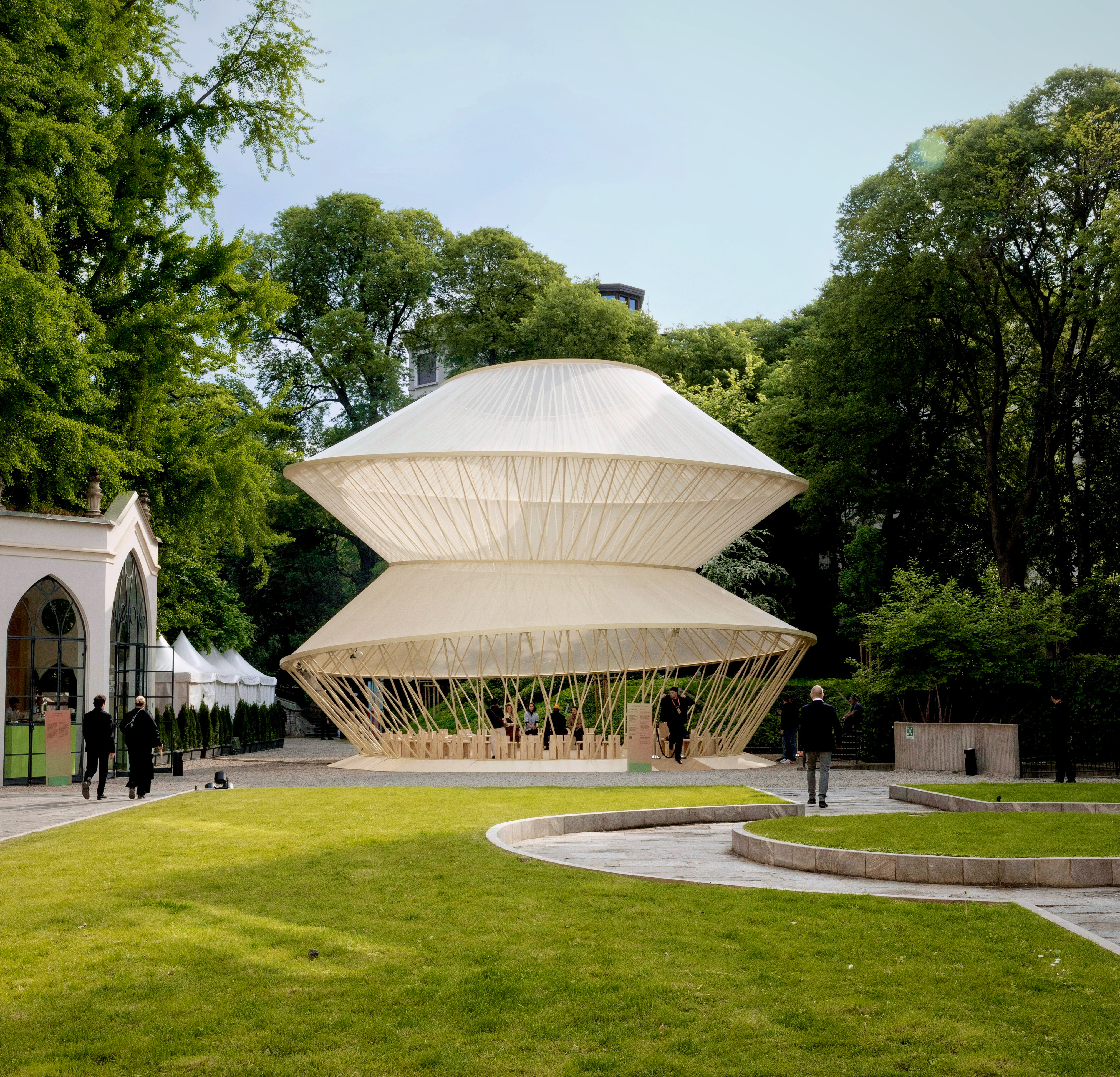
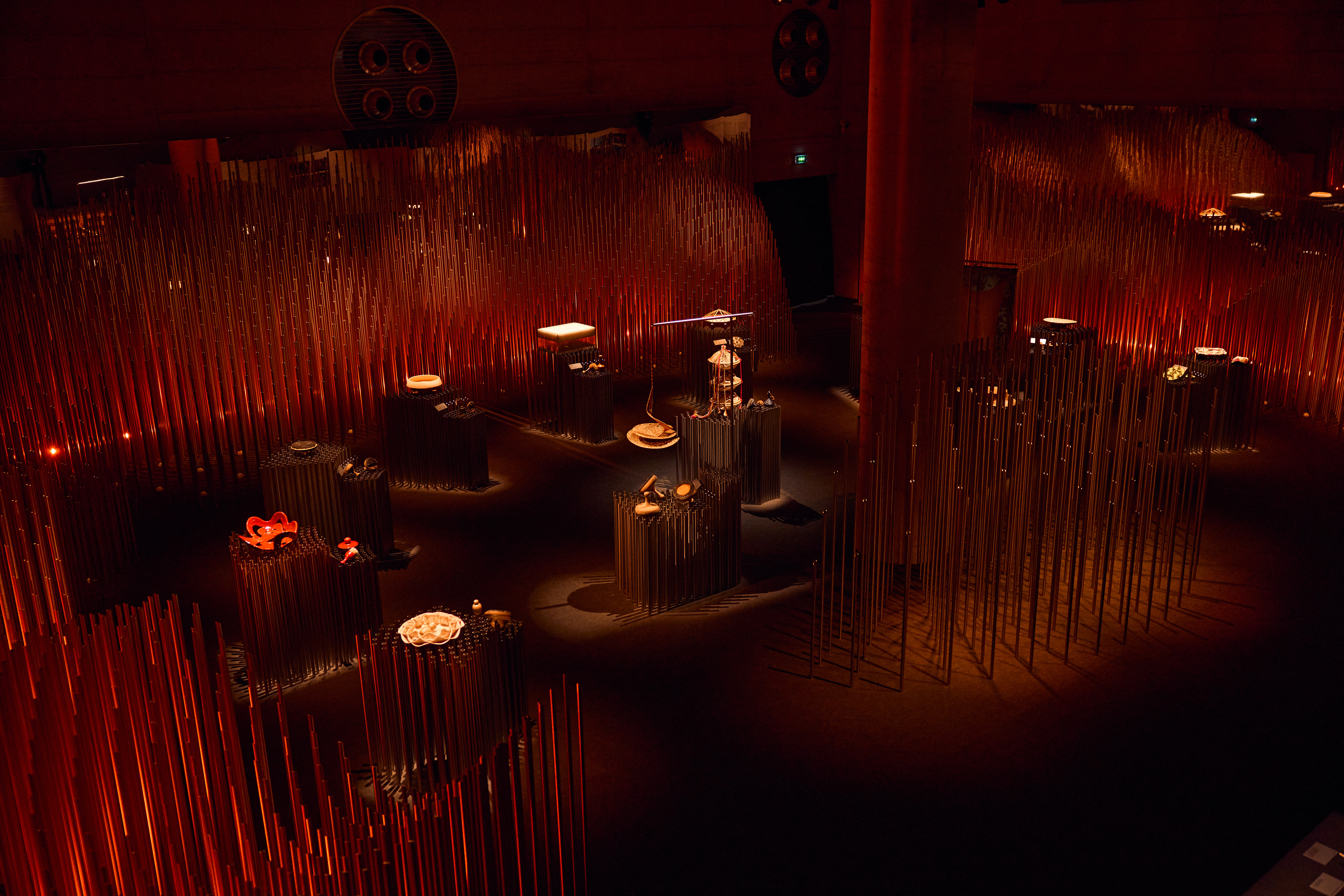
For “When Apricots Blossom”, the story begins at the facade itself. — We did an installation with Bethan Laura Wood using tassels that provide the first intrigue. Then you go through the portal, and immediately down into a very dark space. That descent is a first transportation — you arrive in a vast forest of metal reeds that immerses you into the story of the Aral Sea.
At LOWKEY, the nightclub in Paris, you come from a busy street near Palais Royal through a small courtyard, find a black unmarked door, pass through into a tiny hall of mirrors, and then a staircase takes you underground. The temperature drops, and you start hearing the music. By the time you arrive in the space, you’ve crossed through four thresholds — each one peeling away another layer of the outside world.
The threshold is where presence begins. The story already starts from there.
The Uzbekistan pavilion at Salone del Mobile draws on the Aral Sea region — textiles, food, shelter, memory of a vanishing landscape. How do you translate cultural heritage into spatial atmosphere without turning it into illustration or decoration?
The first step, before doing anything, was to go to Uzbekistan — to meet the people, immerse ourselves in the culture. We went to four cities, met the artisans, and really just experienced it. At the beginning, we didn’t know exactly what story we wanted to tell. It came about through conversation with the locals.
Their culture is so beautiful and rich — thousands of years of this melting pot of inspirations, the Silk Road, craftsmanship, and then the more recent Soviet influence they’re now coming out of. There were so many directions. I work very much like an orchestrator. I bring elements I know — lighting, movement, lightness and darkness — but every project is unique and intuitive. It refines as the concept develops, as I start drawing.
The idea was to tell the story of Karakalpakstan — the autonomous region in northwestern Uzbekistan that has watched the Aral Sea lose more than ninety percent of its volume since the 1960s — but to tell it poetically, looking forward rather than dwelling on loss. Everything had to be about hope. We organized the exhibition around three essentials of life in the region — textiles, food, and shelter — with twelve international designers working alongside Uzbek and Karakalpak artisans to reinterpret each.
The descent into the dark, vast forest of metal reeds is both a reference to the Karakalpak landscape and, on a second reading, a field of chekich — the small carved stamps traditionally used to imprint patterns into Uzbek bread. That doubling carries you into the food chapter of the show, which for us was really a story about hospitality, about the generosity we felt on every visit. After spending time in the space, you start to feel the weight and memory of the Aral Sea, and the larger message of resilience.
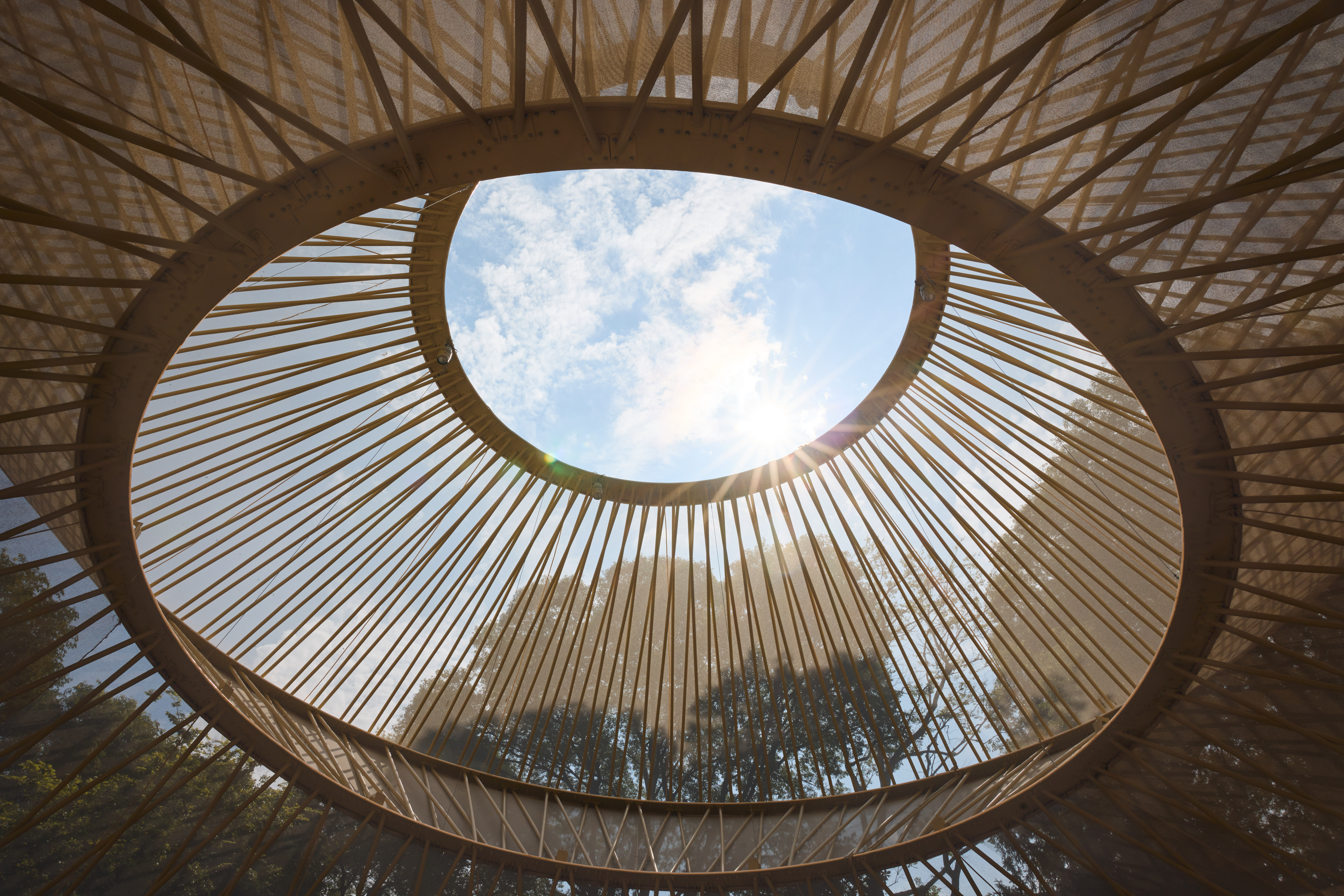
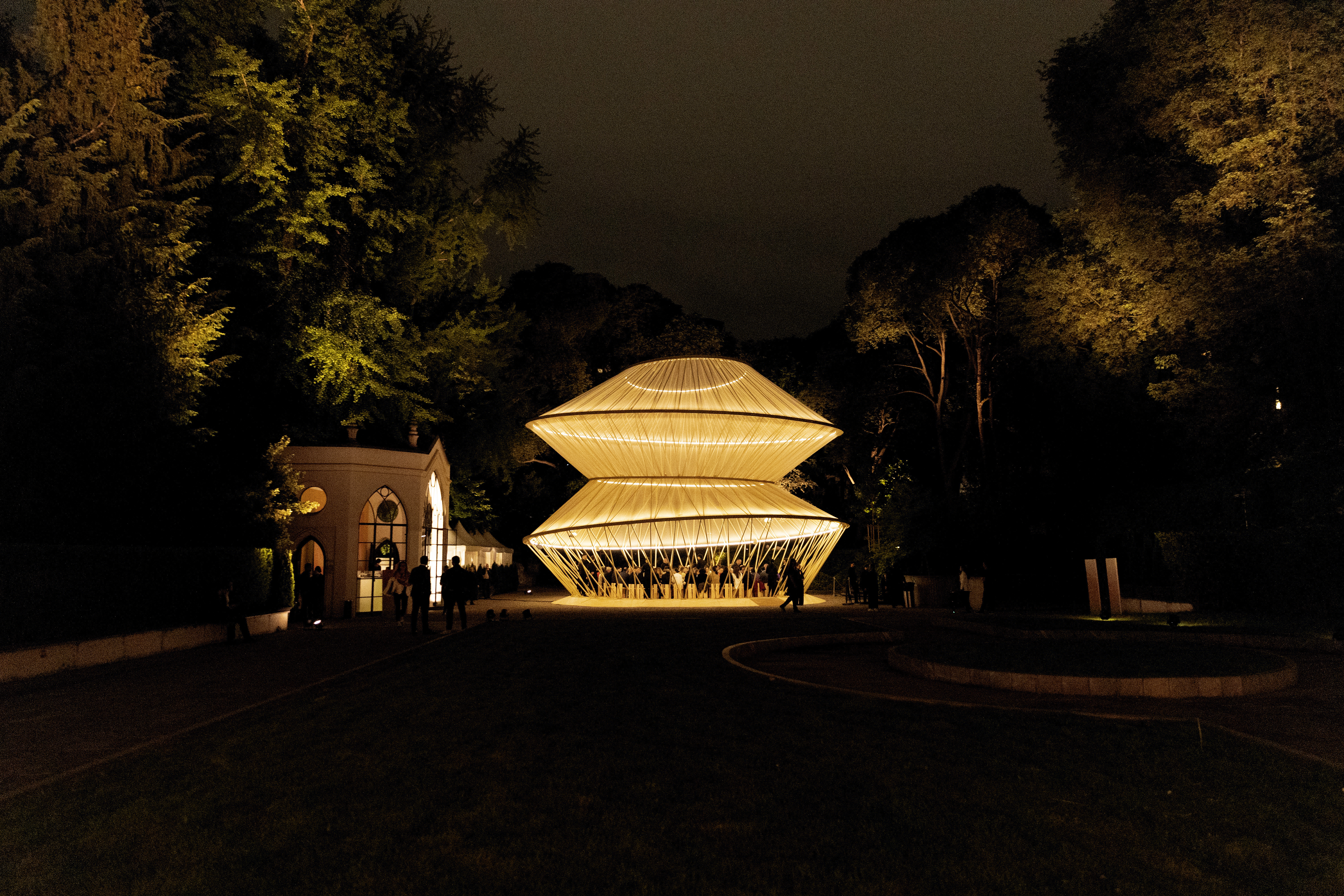
The Garden Pavilion is the final movement. We were inspired by traditional yurt artisans we’d met in the region, deconstructed the yurt shelter, stripped it to its bones, and reassembled it as a very light structure — a pavilion open to the garden and to the sky through its oculus. That’s the point of connection and decompression, of gathering and sharing. It’s all interwoven — not literal illustration.
Clubbing is profoundly bodily — sound vibration, heat, movement, and darkness. How do you design for the body rather than the eye, and how does that approach differ from designing for a more contemplative cultural space?
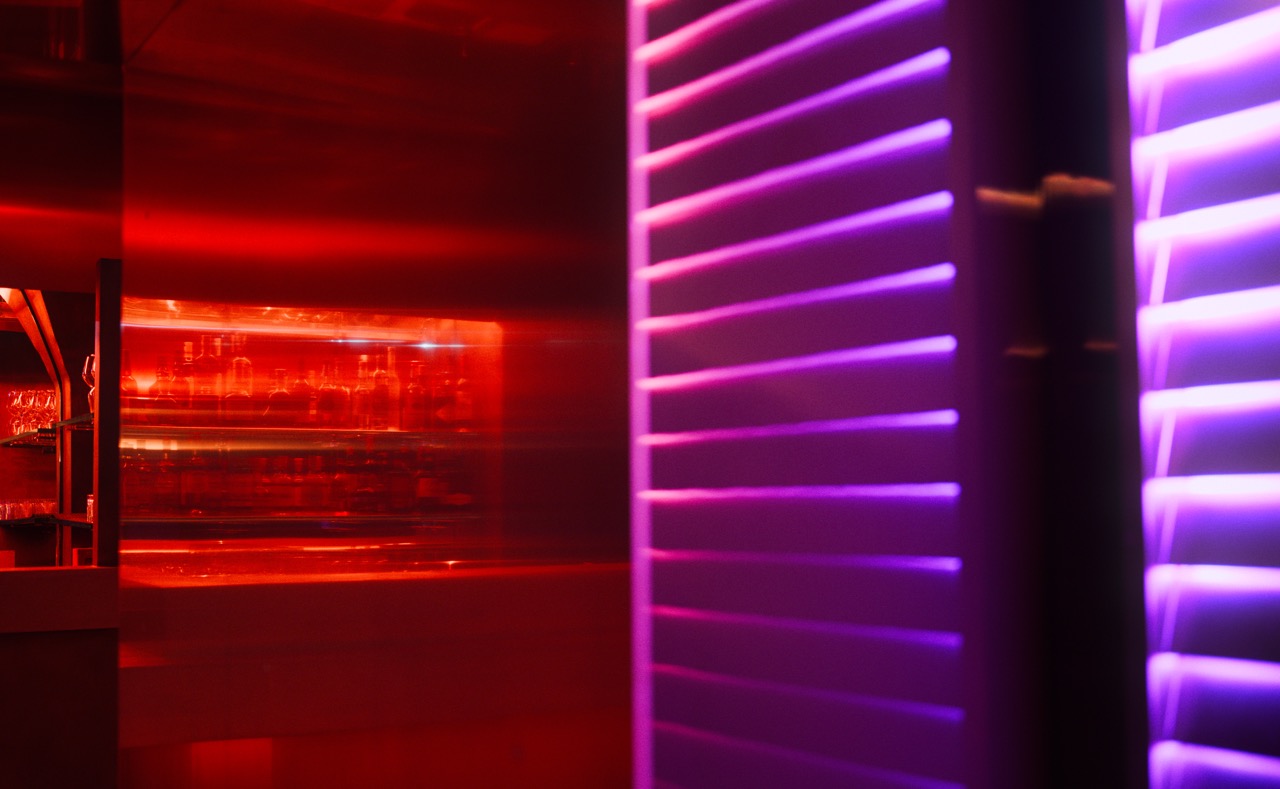
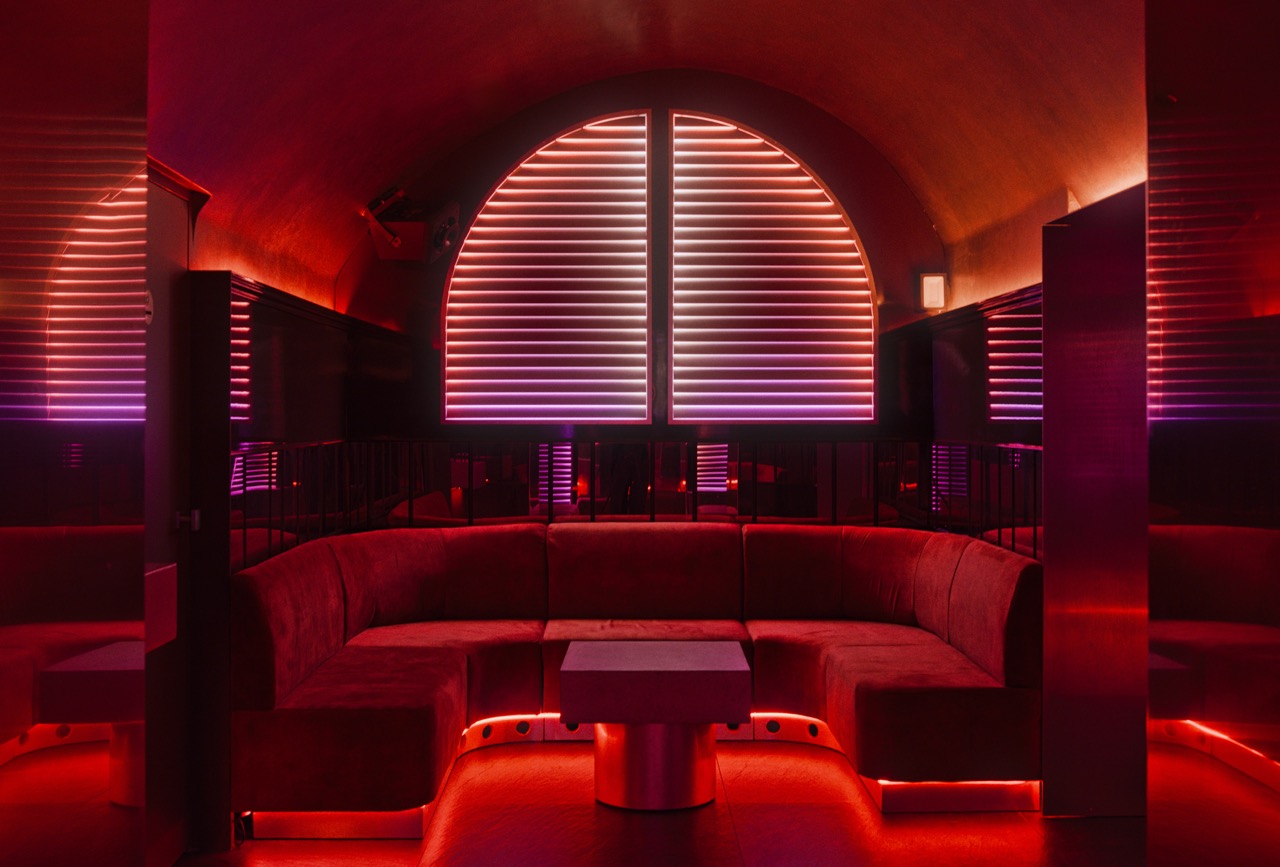
For LOWKEY, the brief was to design for transformation across time — the same space needed to feel completely different at 9 pm and at 2 am. Because it used to be a basement cellar (hiding one of Paris’s oldest gay bars, L’Insolite) — we could completely control the environment and build layers of new memory. I designed a persienne shutter system: very thin, all stainless steel, hiding a shallow light box that is entirely controllable. This creates a feeling of voyeurism, something intriguing and sexy about what could be behind. Early in the evening, it’s a sunset mood — peaceful, intimate, a speakeasy. As the night progresses, the lighting intensifies, transforms, and the music gets louder. At the peak, it starts strobing — you feel almost like there’s a lightning storm outside. You lose all sense of where you came from, and you’re just fully living the moment.
How do you create pockets of quiet, conversation, or stillness inside a high-energy environment — and how do you keep those moments connected to the larger intensity around them rather than isolated from it?
The body always knows where it is in the journey. Tempo is everything — contrast and restraint. You can’t design the peak without designing the valley.
It is not that there are separate quiet zones; the space moves with you. At LOWKEY, early in the evening, you’re in a kind of suspended sunset, intimate and conversational. The intensity builds around you. The persiennes make you feel like there’s something beyond — that perhaps you’ve gone upstairs rather than down, that there’s a world outside you can’t quite see. That mystery, that sense of being in a contained but somehow infinite box — that’s what holds both the quiet and the energy in the same room.
There is a quote: The DJ used to watch the crowd dance, now the crowd watches the DJ dance. How does the shifting role of the DJ — from anonymous technician to performer — reshape the spatial logic of a club? Is the booth a stage, an altar, or something else entirely?
There’s a spirituality in a lot of what we do in a nightclub — not religious, but spiritual.
We’re all looking for a higher self, a release, a moment of euphoria and complete disconnection from our lives. The DJ booth today is very much like what an altar used to be — a focal point for cultural transmission and collective transcendence. Yet at LOWKEY, the DJ is the extension of the bar; it felt more convivial and intimate to have it there.
Aren’t we all so fed up with the nonsense in this world that we need, more than ever, these pockets of release? The architecture has to hold that. It has to create the conditions for people to completely unleash and lose themselves in the moment.
A club, like a pavilion, is a temporary social ecosystem. How do you ensure that the space serves community — its neighbourhood, its audience — rather than becoming a hermetic bubble that ignores its context?
Community is all about connection – when you provide a space for people to appropriate and connect to each other and share. In a nightclub, it’s all about shared energy, release, disconnection from one world and being fully tuned into another. Inside the Garden Pavilion at the Uzbekistan project, we ran a full program of talks, workshops, breakfasts, dinners — a gathering space that offered a necessary slowdown from the overstimulation of Salone. A very different, but equally important, proposition. Nowadays, people are really looking for connection — to be outside their environment, to live a new atmosphere. We are bombarded with so many images and so much stimulation that we’ve become numb. The question I keep asking is: How do we reconnect to each other and to a space? One answer lies in third spaces — not home, not work, not a restaurant. The space in between that actually makes life worth living. That’s why cities are attractive. But it also doesn’t need to be man-made; this can also happen in nature, with the most beautiful connection to the elements. I’m so profoundly curious and passionate as a designer to the infinity of possibilities.
Why is also known for its museum work — The Met, the Louvre, Dib Bangkok. How does designing for a permanent collection differ from the temporary, high-intensity experiences you’re known for — and does the same spatial storytelling logic apply?
The logic is the same, though the tempo is different.
Designing a museum is designing with empathy. You’re thinking about how people encounter objects, memory, knowledge — how they move, pause, reflect. In some ways, it asks for even more sensitivity.
With a temporary installation or nightclub, intensity can be immediate. In a museum, storytelling unfolds more slowly. But it is still spatial storytelling.
On a project like the Louvre, the stories are so rich that the challenge becomes editing—finding the through-line that lets different visitors enter at different depths. And craftsmanship becomes even more essential. Detailing matters enormously. Material transitions, light, proportion, casework — these things shape the emotional experience as much as the collection itself.
It’s still about creating a memorable encounter, just through a quieter register.

At a moment when venues are designed to be photographed as much as experienced, how do you defend genuine encounter and presence? Is there a tension between creating something visually powerful and creating something that resists consumption as an image?
If the space is well designed and executed, and it works physically, the image takes care of itself. I always get a kick out of seeing at the end of a project how people have documented it, if at all — the pictures they’ve taken, the videos — because everyone perceives space in a different way. I’m always fascinated by that. I don’t want to control, quite the opposite. No matter what you photograph, there has to be beauty. That is one of the prerequisites, but it doesn’t dictate the design. I don’t do it for that, but there won’t be an ugly picture.
People need to appropriate the space — We’re all different, we see things differently. We have different backgrounds, different perceptions. That’s where the real life of a space lives. It’s not in the image — it’s in being reinterpreted, the appropriation each time, by whoever is there. At the Pavilion, some people stayed a long time, and others even returned multiple times. In a fair like Salone, where you are overstimulated by so much constant information, it was a testament that we did something right.
Both the nightclub and the Salone pavilion involve deep collaboration with artists, artisans, curators, and clients. How do you manage creative authority in those multi-voice processes without diluting your architectural vision?
I listen. And I take the time to understand everyone’s POV. Diplomacy is key to the success of every project. We say it takes a village, but it really does. And it’s impossible to realise without the collective. It’s the collective that makes the project so special. Everyone brings forward a brick to the edifice. Our job is to make sure every brick fits in the right place for the edifice to stand strong and be cohesive. I always bring a wide pool of experts for the specificities of the project.
The word “immersive” has become almost ubiquitous in cultural programming and design. What does genuine immersion mean to you — and what are its limits or dangers as a design goal?
For me, immersion is about being present in the moment and connected to the now. We can argue that experience is the new luxury; it’s what we yearn for most, and that’s important to cater to.
But it’s more than immersion — it’s storytelling. Immersion has this connotation of control. And it’s not about control, unless of course that’s what the brief is. It can be dark, it can be open, it can be light. You can feel squeezed, or you can feel vast. It’s really about atmosphere, contrast, and restraint.
What I’m trying to do is transform memory into a living presence — to make you be in the present all the time. It’s another art form, beyond architecture. It lets us dream. When it’s good, it creates memory—and memory is what drives the work. It’s about how the body experiences it, the emotions, the goosebumps. That’s what drives me: to create a space where emotion can happen and people deeply connect. And what you truly remember — from a space, from a person — is how they made you feel.
The interview took place during Salone del Mobile in Milan in April 2026.
Related: Oskar Bocquillon
Why Architecture
Uzbekistan Art&Culture Development Foundation
Kulapat Yantrasast
LOWKEY
